Only 1 in 3 LGBTQ+ Travelers Feel Comfortable Being Out on the Road, Booking.com's 2026 Travel Proud Report Finds
Sarah
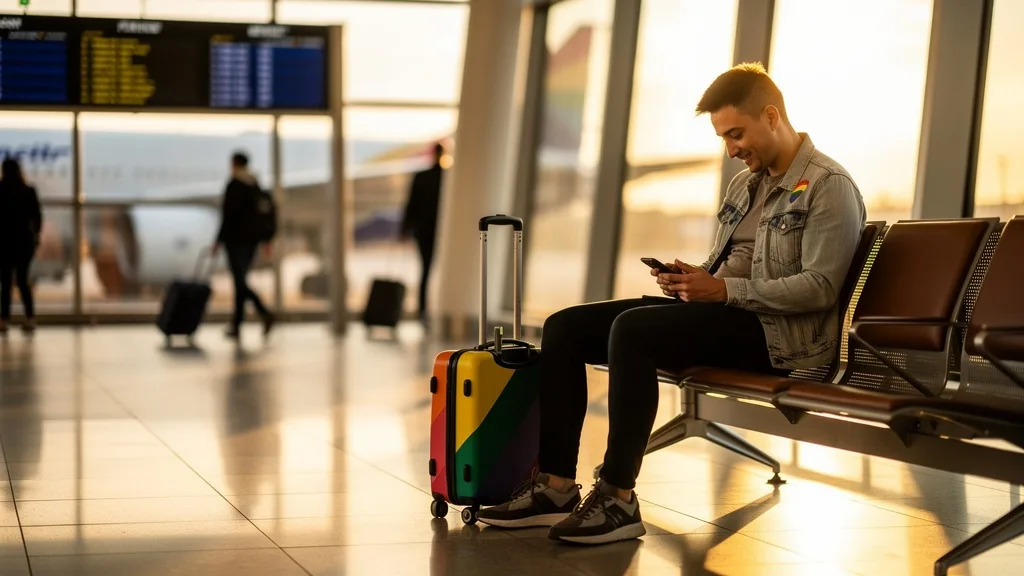
Only 1 in 3 LGBTQ+ Travelers Feel Comfortable Being Out on the Road, Booking.com's 2026 Travel Proud Report Finds
Five years after launching its Travel Proud program, Booking.com has published its most expansive LGBTQ+ traveler survey to date — and the findings reveal a striking disconnect between how people present themselves at home versus on the road.
Polling 13,331 LGBTQ+ travelers across 19 countries between February and March 2026, the research shows that only 31% are 'out' when they travel, compared to 68% who are out to close friends. Meanwhile, 40% say they are willing to conceal their identity entirely in order to experience a bucket-list destination — a trade-off that speaks to the persistent tension between self-expression and personal safety in global travel.
Precautions Are Rising
Nearly half of respondents (44%) say they are taking more precautions than they were a few years ago. Common measures include sharing live locations with trusted contacts (25%), deleting dating apps before border crossings (16%), using VPNs to mask online activity (19%), and carrying burner phones (18%). Nearly half (48%) say they routinely scan their surroundings before showing affection to a partner in public.
The data is particularly sobering for trans travelers, who are the only subgroup where the share feeling more anxious about travel (43%) outpaces those who have become more relaxed. For most groups, being out in public after dark is the top anxiety moment; for trans travelers, using gendered facilities tops the list (24%).
The Safest Are Often the Most Hidden
One of the report's sharper findings: travelers who identify as 'not out' report the fewest negative experiences. Only 34% of closeted LGBTQ+ travelers had a negative identity-related experience in the past twelve months, compared to 62% of all LGBTQ+ travelers globally and 73% of trans travelers. They are also the only subgroup where a majority (53%) did not report feeling anxious when traveling.
"The 'safest' LGBTQ+ travelers are often the ones who are most effectively able to hide parts of who they are," the report notes — a framing that underlines how much work remains before inclusive travel becomes the default rather than a niche.
AI Filling a Gap
Despite the anxiety data, there are positive signals. Some 82% of respondents reported at least one positive identity-specific experience in the past year — including staff using correct pronouns (34%), visible pride flags at properties (32%), and gender-neutral bathrooms (32%). And 58% believe acceptance has improved in recent years.
AI tools are also becoming a meaningful resource: 66% used AI to plan travel in the last year, with 43% saying they trust AI for objective, non-judgmental travel advice about their identity. Notably, 37% say they feel safer asking AI sensitive questions about local LGBTQ+ conditions than asking a human.
Travel Proud at Five Years
The report marks the fifth anniversary of Booking.com's Travel Proud program, which now covers more than 142,000 properties across 20,000+ cities and is available in 11 languages. Properties complete third-party inclusive hospitality training to earn the badge, and travelers can filter for them directly on the platform.
"We're encouraged by how the program has grown and how enthusiastically it has been embraced by so many of our partners around the world," said Matthias Schmid, SVP Accommodations at Booking.com. "Despite the challenges, and the increased precautions LGBTQ+ travelers are taking in order to feel safe, we are inspired by the 66% globally who prioritize trips where they can be 100% themselves."
The full Travel Proud Research Report is available on Booking.com's newsroom.
Source: Booking.com Newsroom